
How to Bring a Hands-On Science Assembly to Your Elementary School (Without the Headache)
- Dave Daniels

- Mar 8
- 4 min read
A practical guide for Wisconsin principals looking for NGSS-aligned programs that students will actually remember.
Every principal knows the challenge: you want to bring something meaningful and memorable to your students, but between budget constraints, scheduling logistics, and curriculum requirements, finding the right program can feel like one more thing on an already full plate.
This post walks through what to look for in a quality school science assembly, how to evaluate whether it fits your curriculum, and how to make it work financially — even in a tight budget year.

What Makes a Science Assembly Worth Your Time
Not all school assembly programs are created equal. Some are entertaining but thin on educational value. Others are curriculum-aligned but struggle to hold student attention. The best programs do both: they create a genuine sense of wonder while delivering content that extends into the classroom.
When evaluating any science assembly for your school, here are the questions worth asking:
Does it align with NGSS standards? The Next Generation Science Standards emphasize hands-on, inquiry-based learning. A program that simply lectures students about science — even with flashy visuals — falls short of what NGSS asks of us. Look for programs that invite students to observe, handle materials, ask questions, and make connections.
Does it serve multiple grade levels? Full-day programs are only cost-effective if they can flex across grade bands. A quality presenter should be able to adapt content for kindergartners and fifth graders in the same day without either group feeling talked down to or left behind.
Does it reduce work for your staff — or add to it? The best visiting programs handle their own setup and teardown, provide teachers with follow-up materials, and require minimal coordination on the school's end. If a program demands significant staff preparation, that's worth factoring into your decision.
How Forest Whales Fits Into a Wisconsin Elementary School Day
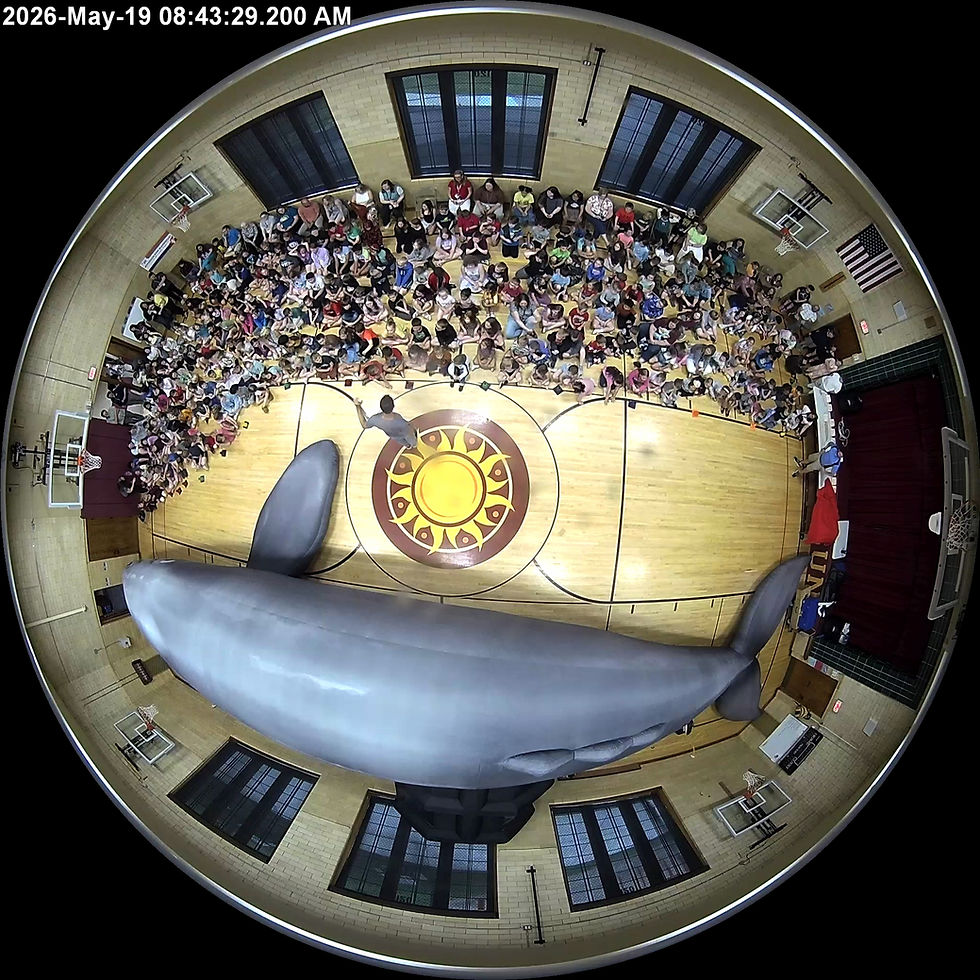
Forest Whales is a traveling science program based in Wisconsin. We bring a 56-foot inflatable gray whale — life-size — directly to your gymnasium, along with a collection of replica whale bones, fossils, and hands-on exhibits.
Here's what a typical school day looks like:
Morning assembly: The full school gathers for an opening presentation inside or alongside the whale. Students learn about whale anatomy, ocean ecosystems, and the fossil record in an immersive, story-driven format.
Small group rotations: Throughout the day, classes cycle through in smaller groups for deeper, hands-on exploration. Students handle replica bones, examine fossil shark teeth, and engage directly with the presenter.
Teacher resources: Every visit includes curriculum documentation tied to NGSS standards, plus digital lesson guides teachers can use for follow-up learning in the days after.
Fossil shark teeth: Each student receives a fossil shark tooth replica to take home — a tangible connection to the experience that keeps the conversation going.
Setup and teardown are handled entirely by Forest Whales. From the time you unlock the gym doors to the time we drive away, your staff's job is simply to enjoy it alongside your students.
NGSS Connections
Forest Whales programs address the following content areas, which map directly to Wisconsin's science standards for K–8:
Structures and functions of living organisms (whale anatomy and adaptations)
Ecosystems and food webs (ocean food chains, predator-prey relationships)
Earth's history and the fossil record (fossil identification, geological time)
Human impact on the environment and conservation practices
Curriculum documentation is available upon request before your booking, so you can share it with your science coordinator or curriculum director.

Making It Work Financially
Budget is often the first question principals ask, and it's a fair one. Here's how schools across Wisconsin have made Forest Whales work:
Title I and school improvement funds. Many Wisconsin Title I schools have used discretionary enrichment funds to cover or offset the cost of a visit. If your school qualifies, this is worth exploring with your district's federal programs coordinator.
PTA and parent organization support. Parent groups are often looking for a visible, high-impact way to direct their fundraising. A life-size whale in the gym is exactly the kind of event that generates enthusiasm — and photographs — that justify the investment.
Shared visits with neighboring schools. Forest Whales offers reduced pricing when two or more nearby schools coordinate a visit in the same area on consecutive days. If you have a relationship with a neighboring principal, this is one of the simplest ways to bring costs down for everyone.
Community partnerships. Local businesses, civic organizations, and community foundations have sponsored Forest Whales visits for schools in their area. If your school has an active community partnership program, a sponsor conversation is worth having.
Pricing varies based on location, group size, and travel. Contact us directly for a quote tailored to your school.
What Principals Are Saying
"David Daniels' program is not only informative, but he also brings laughter and fun into the experience. His knowledge and understanding of the child's developmental stages help David target his program to meet the needs of the group. Not to mention that the whale is so fun for kids to see and interact with. I would highly recommend having this program brought into schools." — Caleb Feidt, Principal, St. Anne's School, Wausau
Ready to Learn More?
Forest Whales serves schools throughout Wisconsin and is available for Midwest travel. Our schedule fills quickly — particularly in the fall and spring — so if you're interested in a visit for the current or upcoming school year, the best first step is a quick email.
You can reach Dave Daniels directly at dave@forestwhales.com, or use the contact form at forestwhales.com.
We're happy to answer questions, provide curriculum documentation, or put together a quote before you make any decisions.
Forest Whales is an educational science program based in Wisconsin, serving K–8 schools, public libraries, and community events across the state and the broader Midwest.


Comments