
The Boy with the T. Rex Jaw

The guy was hard to miss.
Tall, broad-shouldered, with the kind of presence that fills a room without trying. He walked into the Forest County Potawatomi gymnasium in Crandon, Wisconsin and, while his son drifted toward the fossil table to examine the T. rex jaw, the man started talking to me about whales.
Not the way most people talk about whales. Not the way I talk about whales.

He told me he goes to Alaska almost every year, sometimes every other year, to help with the annual bowhead and beluga hunt. He is Potawatomi, but his children are half Inupiaq, and his connections to the Arctic run deep. He pulled out his phone and showed me photographs.
I was not prepared for what I saw.
The first image: a man standing at the edge of a boat, looking out over the ocean. The water surrounding the vessel was the brightest red I have ever seen in a photograph. Not a filter. Not a sunset. The ocean itself, turned red.
The second: multiple polar bears standing at the edge of the ice, patient and enormous, watching the hunters. Waiting. He said most large predators don't bother him. Black bears, cougars, wolves. He's been around all of them.
"But polar bears," he said, shaking his head. "You don't mess with polar bears."
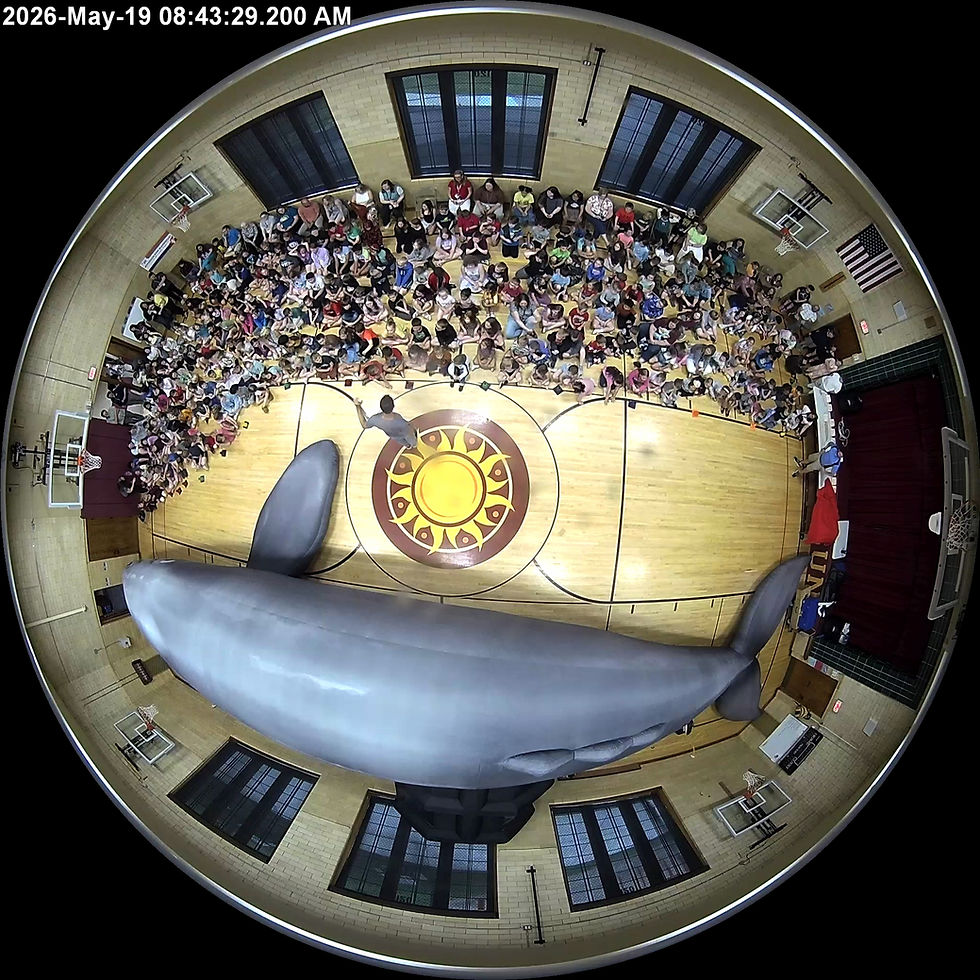
The third: a bowhead whale literally the size of Clara, our inflatable whale, pulled up onto the ice. The snow around it stained deep red. Twenty men standing on and around the animal, posing with their quarry. The whale dwarfed them.
The hunt, he explained, is a combination of centuries stacked on top of each other. Most of the hunters work from boats, using harpoon cannons that date back to the 1800s. Some of those harpoons get reused. But a few of the traditional hunters still go out in umiaks, the ancient walrus-skin boats, and do it the old way.
Those men, he said, sometimes four or five of them, will harpoon a whale and get towed behind the animal across the open water, holding on while the bowhead runs, until it finally tires and either bleeds out or dies from exhaustion.
He smiled when he said this. "Those guys are a different kind of crazy."
I should say something here, before anyone asks.
I would never do this. It is not something I could do, and it is not something I would choose to do. But standing next to a man who has, and whose children someday will, whose community has for thousands of years, is a different kind of education than anything I could offer inside a gym.
Indigenous subsistence whaling is federally recognized, carefully managed, and bound by traditions that predate every institution that now oversees it. The Inupiaq relationship with bowhead whales is not a relic. It is alive, and it is complex, and it is not mine to judge.
What I can tell you is that this man loves those animals. Not in spite of hunting them. Alongside it. The way people who live closest to wild things often do.
I thought about the bowhead whale I tell people about inside Clara. The one harvested in 2007 with a harpoon tip lodged in its neck, a style of tip that stopped being manufactured around 1890. The animal was approximately 200 years old.
The man in Crandon told me that old harpoon tips break off and stay embedded in the animals. That some whales survive and keep swimming. That the hunters reuse the cannons and the shafts but the tips sometimes stay behind.
The science still holds. A 200-year-old whale, carrying a piece of the 19th century in its body, finally harvested by the same people who have always hunted them. There is something in that story that I am still working out because it is both beautiful and real. It's as real as it gets.
Before he found me, a young girl had pulled me aside with a story she'd heard. A tribe, starving through a brutal winter, discovered a dead whale washed up on the shore. They moved inside it. They ate the meat from within the walls around them and survived until spring.
Ten minutes later, this man told me the same story.
I don't know the origin of the legend or which people it belongs to. But I stood there thinking about the children who walk inside Clara every day, laughing and asking questions and touching fossils, and I thought: people have always found a way inside the whale.
At some point during our conversation, I glanced over at his son.
The boy was still at the fossil table. He had both hands on top of the T. rex jaw, examining every surface. He wasn't listening to us. He was somewhere else entirely, somewhere 65 million years in the past, his hands on an animal that ruled the world before the ocean even knew what a whale was.
His father was excitedly telling me about standing on Arctic ice next to a bowhead the size of a school bus.
And I was standing in a gymnasium in Crandon, Wisconsin, my eyes wide and jaw dropped, trying to figure out which one of us was having the better day.
Forest Whales brings hands-on marine science and paleontology programming to K-8 schools, libraries, and community events across Wisconsin and the Midwest. To bring Clara to your community, visit


Comments